
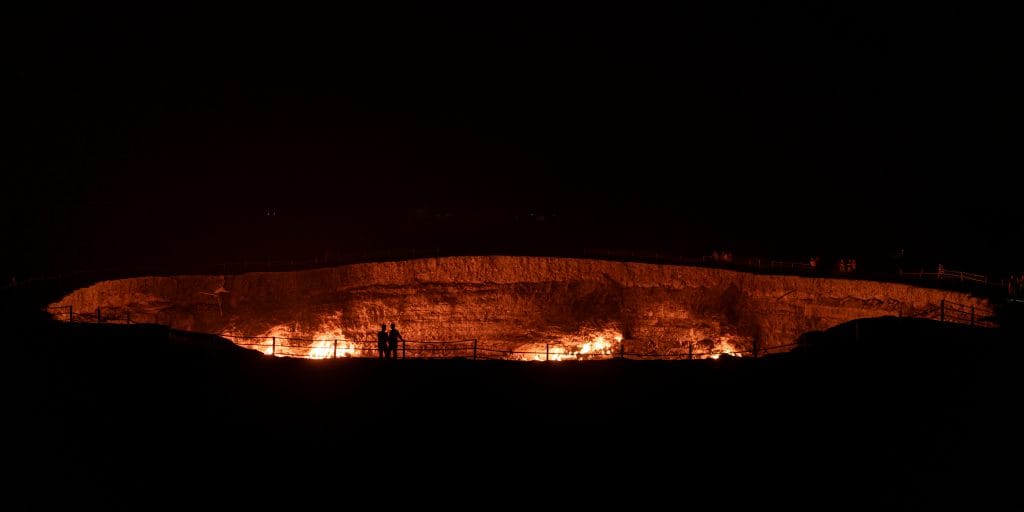
In the middle of Turkmenistan’s Karakum Desert, far from the polished marble avenues of the capital – Ashgabat, fire burns out a hole in the earth, day and night.
This is the Darvaza Gas Crater, one of the most surreal sights in Central Asia and one of the most memorable things to see in Turkmenistan. Known around the world as Turkmenistan’s Door to Hell or the Gateway to Hell – this burning crater has fascinated travellers for decades. At night, flames flicker from the floor of the pit, smoke rises into the desert air and the orange glow gives the landscape an almost mythological quality.
But this extraordinary sight may not last forever.
In recent years, the Darvaza Gas Crater has begun to emit less flame. The once-roaring inferno, which could be seen glowing from a distance across the desert, now burns with reduced intensity.
Turkmenistan has also made efforts to control and potentially extinguish the fire, partly for environmental reasons and partly because of the valuable natural gas still beneath the area. For travellers who have long dreamed of standing beside the Door to Hell in Turkmenistan, time may be running out to see it in its classic fiery form.
But there are upcoming group trips to Turkmenistan, where you can still see this epic sight, before it’s too late.
Where is the Gateway to Hell?
For those wondering “where is the Gateway to Hell?” – the answer is remote, stark and atmospheric: the Darvaza Gas Crater lies in the Karakum Desert of Turkmenistan, roughly 260 kilometres north of Ashgabat, the country’s capital.
The nearest settlement is Darvaza, sometimes written Derweze, from which the crater takes its name. The word itself is linked to the idea of a “gate” or “gateway”, which makes the modern nickname feel strangely appropriate. The site sits in a vast desert landscape of sand, scrub and open sky, a place where the journey is very much part of the experience.
Travelling to the Door to Hell in Turkmenistan is not like visiting a conventional tourist attraction. There are no crowds, no neon signs and no polished visitor centre. The appeal lies in the rawness of the place: the long desert drive, the sudden appearance of a burning hole in the earth, the silence of the Karakum at night and the sense of being somewhere truly unusual.
The history of the Darvaza Gas Crater
The history of the Darvaza Gas Crater is part fact, part Soviet-era mystery. The most commonly told version dates the crater’s origins to 1971, when Soviet geologists were drilling for natural gas in the Karakum Desert. During exploration work, the ground is believed to have collapsed into an underground gas cavern, swallowing drilling equipment and leaving behind a crater around 70 metres wide.
The escaping gas presented a serious danger. Methane and other gases could spread across the area, creating a risk for nearby people and livestock. The engineers reportedly decided to set the gas alight, expecting it to burn off within days or weeks.Instead, it kept burning.
For more than five decades, the Door to Hell in Turkmenistan became a symbol of the strange legacy of Soviet industrial exploration. It was not built as a monument, a tourist site or created by nature in the usual sense. It was an accident that became a famous place, which is now incorporated into many Turkmenistan group tours. .
Over time, travellers began to seek it out. Photographers, overland adventurers, documentary makers and curious visitors crossed the desert to see the flames for themselves. The Gate of Hell Turkmenistan became one of the most famous things to do in Turkmenistan, not because it was easy to reach, but because it felt so unlike anywhere else.
Why the Door to Hell may be closing
The Darvaza Gas Crater has always raised difficult questions. On one hand, it is a famous Turkmenistan tourist attraction. On the other, it represents a continuous burning of natural gas and a wider environmental concern.
Turkmenistan is a country rich in gas reserves, and the Darvaza area sits within a region where gas has long been central to the economy. In recent years, authorities have explored ways to reduce the crater’s emissions and limit the flow of gas feeding the flames. Reports suggest that nearby wells have been used to divert or capture gas, reducing the intensity of the fire.
For travellers, this creates a rare window of urgency. The Door to Hell Turkmenistan still burns, but not with the same force it once did. Those searching online for Darvaza Gas Crater tours, the Gate of Hell in Turkmenistan or things to see in Turkmenistan should be aware that the experience may be changing.
This does not make the site less interesting. In some ways, it makes it more compelling. To stand beside the crater now is to witness a place in transition: part geological accident, part industrial relic, part disappearing wonder.
The clock is ticking though and it’s becoming more apparent that the “ever burning” Darvaza Gas Crater, may not actually burn forever.
Visiting the Darvaza Gas Crater with Untamed Borders
Untamed Borders organises a group trip to Turkmenistan that includes a visit to the Darvaza Gas Crater. For many travellers, this is the highlight of the journey: a night in the desert beside one of the most unusual sites in Central Asia.
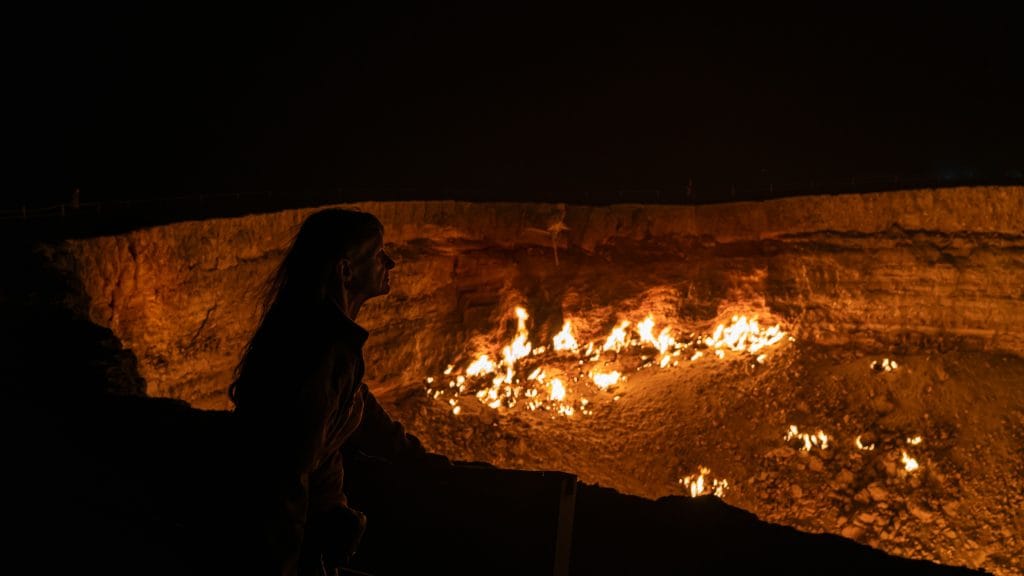
A visit to the Door to Hell is often most powerful after sunset. In daylight, the crater is impressive – a wide, scorched pit in the desert floor. At night, the atmosphere changes completely. Flames glow against the darkness of the surrounding desert, the heat becomes more noticeable.
But Turkmenistan offers far more than the crater alone. For anyone researching things to do in Turkmenistan, an adventurous trailer will find a fascinating country, which is rarely explored by international visitors. Turkmenistan is the least visited of all the Central Asian nations and has a mystique, due to its history of isolationism.
Ashgabat is known for its vast white-marble architecture, monuments and unusual urban design. Ancient Merv, once one of the great cities of the Silk Road, offers a completely different perspective on the country’s history. Desert landscapes, remote communities, archaeological sites and Soviet-era legacies all form part of the wider experience. There are also impressive canyons, a Caspian Sea coastline, rural mountain settings, plus much more to be experienced on a Turkmenistan group trip.
That combination is what makes the country so interesting. The Door to Hell in Turkmenistan may be the image that captures people’s imagination, but the journey around it reveals a country that is far more complex than a single fiery crater.
Why go now?
Some places feel timeless. Others are defined by change. The Darvaza Gas Crater belongs increasingly to the second category.
For decades, travellers could assume that the Gate of Hell would simply keep burning. It had already outlasted the Soviet Union, generations of visitors and repeated discussions about whether it should be closed. But the recent reduction in flames suggests that the crater’s most dramatic days may not continue indefinitely.
That is why now is a particularly meaningful time to visit. To see the Doorway to Hell in Turkmenistan, while it is still burning, is to witness one of the world’s strangest travel experiences before it changes forever. It is not just another stop on a list of things to see in Turkmenistan. It is a living, fading piece of modern history.
Whether you know it as the Darvaza Gas Crater, Turkmenistan’s Door to Hell or the Gateway to Hell, the reality is the same: this is one of the world’s most extraordinary desert sights.
And one gate that may not stay open for much longer.
For more information about Untamed Borders’ upcoming group trips to Turkmenistan, please email – info@untamedborders.com.