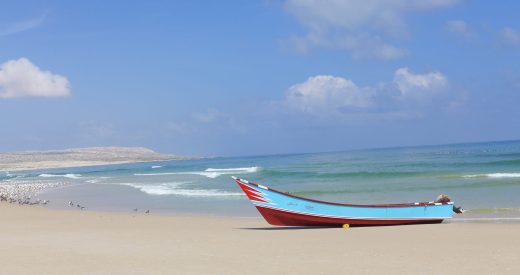
An autonomous state in northeastern Somalia, Puntland was once an ancient kingdom which had strong trade links with Egypt exporting ivory, animals, gold, blackwood and aromatic resin. More recently though it contained the largest sultanate ever established in the territory, the imperial ruling house of Warsangali.
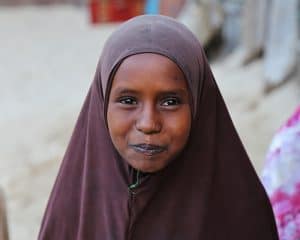
Capital of Puntland, Garoowe is the heart of the region and houses the regional parliament, presidential palace and government ministries as well as a local media and cultural hub. Goat and camel raising form the basis of the economy, and frankincense and myrrh are collected from wild trees. Garowe is the third largest city in Puntland after Bosaso and Galkayo.
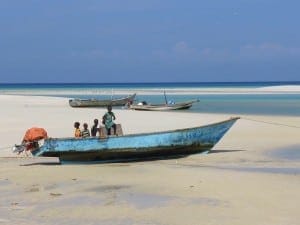
The easternmost point of the African Continent, Cape Guardafui gets its name from ancient Italian meaning “look and escape”. Whilst the areas treacherous waters were once the site of countless shipwrecks, today the unspoilt white sand beaches and blue waters rolling beneath stretches of towering sandstone cliffs make for a rewarding visit.
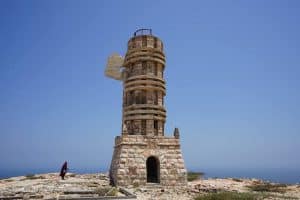
The Italian Somaliland authorities built the first lighthouse on the headland, inaugurated in April 1924 as the Francesco Crispi Lighthouse. It was a simple, functional metal-framed lighthouse built atop the headland.
A large-scale rebellion against Italian rule in that part of Italian Somaliland was underway at the time and the lighthouse suffered some damages during the attacks. This was one of the reasons that prompted the authorities to build a stronger, stone and reinforced concrete lighthouse, which was inaugurated in 1930. The striking new lighthouse was built in the shape of an Italian fascist “Fascio littorio”. The lighthouse, which is no longer in use, still has the huge stone axe blade characteristic of fascist symbolism and typical of fascist architecture promoted by Benito Mussolini. Italian authorities have requested a study to declare the lighthouse an “historical monument” of Somalia and a proposed World Heritage Site.
Combine a visit to Puntland with surrounding regions of Somalia and/or Somaliland.
Puntland occupies the north-eastern corner of Somalia, facing both the Gulf of Aden and the Indian Ocean. Although Puntland as a political entity only dates from 1998, the region has a much older history of Somali sultanates, maritime trade and political autonomy.
Puntland is today officially part of the Somali federal system, but has a high degree of autonomy and has at times been in political dispute with the government in Mogadishu.
But “the land of the Punt” dates back far into history, mentioned in ancient Egyptian texts. Punt traded luxury products such as incense with ancient Egypt, but its precise location remains debated, so Puntland should not be presented as a direct continuation of the ancient kingdom.
However, for centuries, the coast of what is now Puntland had strong commercial connections across the Gulf of Aden and Indian Ocean, particularly with Arabia. Its ports and settlements exported livestock, hides, frankincense and other goods and formed part of wider regional trading networks.
By the 18th and 19th centuries, much of present-day Puntland was controlled by Somali sultanates. The most important was the Majeerteen Sultanate, centred in northeastern Somalia, while the Sultanate of Hobyo controlled territory farther south. These were organised political entities with rulers, taxation systems, armed forces and extensive trading relationships.
During the European scramble for Africa in the late 19th century, the rulers of both the Majeerteen and Hobyo sultanates entered protectorate agreements with Italy. Italian influence was initially relatively limited, with local rulers continuing to exercise considerable authority.
That changed under Fascist Italy. During the 1920s, the Italians moved to impose direct control over northeastern Somalia, defeating the remaining sultanates and incorporating their territories into Italian Somaliland by 1927.
The most famous Italian fascist monument of this era can be found at the very tip of the Horn of Africa - a colonial lighthouse. Untamed Borders organised an expedition to this lighthouse back in 2016 - our Founder, James Willcox, spoke at the Royal Geographical Society in London about the trip.
Following Italy's defeat during the Second World War, Somalia came under British military administration. The former Italian territory subsequently became a UN Trust Territory administered by Italy before gaining independence.
On 1 July 1960, Italian Somaliland united with the former British Somaliland to create the independent Somali Republic. For the first nine years Somalia operated as a civilian parliamentary democracy. In 1969, however, Major General Mohamed Siad Barre seized power in a military coup and established an increasingly authoritarian government.
The northeast would eventually become one of the first regions to organise armed opposition against Barre. By the late 1980s Somalia was descending into civil war. Barre's government was finally overthrown in January 1991, but rather than producing a stable replacement government, the collapse of the regime resulted in the fragmentation of much of the country.
The decisive moment came in 1998. A major constitutional conference was held in Garowe, bringing together traditional elders, political representatives, intellectuals, businesspeople and civil-society figures from northeastern Somalia. After several months of negotiations, the Puntland State of Somalia was formally established on 1 August 1998.
Modern history Puntland has become defined by its ties to piracy. Puntland’s long coastline, near some of the most important shipping lanes on earth, was an area synonymous with banditry in the 2000s and early 2010s, with some of the best-known pirate networks operating from coastal communities in Puntland.
This reputation has now eased thanks to the Puntland authorities’ developing improved maritime and security forces, coupled with international pressure/support, intended to tackle piracy and other organised crime.
The political position of Puntland today means for travellers Puntland, Somalia and Somaliland should not be treated as one uniform destination. Routes, visas, permissions, security arrangements and local authorities can vary significantly depending on where you are travelling.
This page specifically talks about Puntland, make sure to read our Somalia and Somaliland FAQs, for full information on travelling to those destinations. You can also read more about the history of the region in this article.
A visa is required for Puntland.
The region also has a visa on arrival system, which is possible to obtain at both Garowe and Bosasso airports.
To complete this process you have to supply documentation to your tour operator, in advance of travel, which will then be used to ensure your paperwork is in order on arrival in Puntland.
A letter of invitation (LOI) is required for people travelling to the region, this is usually supplied by your tour operator.
For more information about the visa system in Puntland, please email - info@untamedborders.com.
No, travelling to Puntland requires a letter of invitation and this is usually provided by a tour operator. You are unable to travel in the region without an LOI.
Alongside this, travellers require advance permission to visit certain areas and special security support. Movement between cities can often involve police or security escorts, while checkpoints and local permissions must be coordinated in advance.
Journeys to places such as Eyl, Qardho, the mountains of Bari or remote sections of the coast require experienced local guides, reliable vehicles and a route-specific security plan, often accompanied by a security escort.
The best overall time to visit Puntland is usually between December and early March, when conditions are relatively dry and temperatures are more manageable, albeit still very warm.
Puntland is hot and arid, but conditions vary considerably between its interior, mountains and coastline. Garowe lies inland and has a dry desert climate, while Bosaso sits on the Gulf of Aden and can become intensely hot and humid.
Bosaso’s average daytime temperature is around 29°C during January, but midsummer daytime temperatures can reach approximately 40°C. Nights along the coast also remain extremely warm during summer and particularly humid.
The main climatic seasons are:
December to mid-March – Jilaal:
Generally dry and sunny. December, January and February are normally the most comfortable months for travelling, particularly along the coast.
Mid-March to June – Gu:
The principal rainy season. Rainfall is unpredictable and Puntland remains relatively dry, but heavy localised downpours can affect unpaved roads and temporarily disrupt overland journeys.
July to mid-September – Hagaa or Xagaa:
Dry, windy and extremely hot, especially in Bosaso and along the Gulf of Aden coast. This is generally the least comfortable period for visiting coastal Puntland and can be extremely humid.
Mid-September to November – Deyr:
The shorter secondary rainy season. Temperatures gradually become more manageable, although storms and localised flooding can occasionally affect road travel.
The easiest way to reach Puntland is by air and most international visitors arrive into Bosaso International Airport.
Ethiopian Airlines operates direct flights between the international hub in Addis Ababa and Bosaso. Meanwhile, regional airlines connect Bosaso with destinations elsewhere in Somalia, the Horn of Africa and the Gulf.
There are also flights to Garowe International Airport, but these largely connect Puntland to Mogadishu, Djibouti and other smaller regional hubs.
The Untamed Borders team will be able to provide advice on the best potential routes for your trip to Puntland.
Overland Travel to Puntland
Overland travel into Puntland is not practically possible due to conflict in neighbouring regions.
Road routes from Somaliland pass through politically disputed and security-sensitive areas of Sool and Sanaag, where conditions and territorial control can change regularly.
Travelling north from Mogadishu or central Somalia involves long journeys through areas affected by militant activity, clan tensions and armed checkpoints. There is also no routinely used international tourist crossing directly between Ethiopia and Puntland.
Puntland has its own regional government, police and security forces and the region has avoided some of the prolonged instability experienced in southern and central Somalia. However, it still has its challenges.
There are also different security landscapes in different parts of Puntland - security conditions differ greatly in Garowe, Bosaso and, Eyl, compared to more rural mountain areas and stretches of the coastline.
Both Islamic State and al-Shabaab have operated in parts of Puntland, particularly in the remote Cal Miskaad and Golis mountain areas.
However, travel in other parts of the region can be done safely, with the right experienced support. For a full security overview for Puntland and for the latest information, please email our team on - info@untamedborders.com.
Puntland is a deeply conservative Muslim society and visitors should dress modestly throughout their trip.
Women should wear a headscarf in public and cover their shoulders, chest, arms and legs. On Untamed Borders group trips, we ensure that an abaya is provided for women guests - a traditional long, flowing outer garment that covers the body.
Men should wear long trousers with a lightweight long-sleeved shirt. Shorts and sleeveless tops are not appropriate.
Lightweight and breathable fabrics are strongly recommended because of the heat in the country and a cap is recommended during the intense heat of the day. Suncream is also advised.
The best option for visitors is to bring US dollars in cash into Puntland.
Many hotels, restaurants and people within the tourism sector accept US dollars and if needed, these can also be exchanged into Somali shilling for smaller local purchases.
The Untamed Borders team can assist guests in exchanging US dollars into local currency, whilst in some of the larger urban areas in Puntland.
Credit and debit cards are not widely accepted and ATMs that accept international cards are limited and may be unavailable all together, particularly outside of towns and cities.
Mobile money is used for a large proportion of everyday payments by Puntlanders, however, this isn’t usually feasible for short-term visitors, as it’s connected to a local SIM card and requires a local address to set-up.
The Untamed Borders team will advise travellers how much cash to bring, ahead of your departure.
Somali is the principal language spoken throughout Puntland and is the official language of the regional government.
Arabic is widely encountered and understood too, particularly in religious education, mosques and Islamic contexts. The region sits close to the Arabian peninsula and there has been a cultural exchange across the Gulf of Aden for centuries.
English is spoken by some government officials, businesspeople, university students and people working with international organisations - although this is largely concentrated in urban areas.
Italian may also occasionally be spoken by some older people, reflecting Somalia’s colonial history, but it should not be relied upon.
Mobile data is the primary means to access the internet in Puntland, with a decent level of connectivity in larger urban areas.
Although, speeds and reliability can vary depending on the location and local demand at the time. There can also be fluctuations in speed and connectivity all together, due to issues with power supplies (the region can have intermittent power cuts).
Hotels and restaurants in Garowe and Bosaso may provide Wi-Fi, but visitors should not expect uninterrupted service.
Data coverage becomes much less reliable on long road journeys, in mountainous areas and along remote sections of the coast. Some isolated places may have no usable signal at all.
Food in Puntland is generally hearty and based around meat, rice, pasta and flatbread. Its cuisine reflects Somali pastoral traditions as well as centuries of maritime trade with Yemen, Arabia, India and the wider Indian Ocean world.
Breakfast commonly includes laxoox or canjeero, a soft, slightly fermented pancake-like flatbread. It may be eaten with honey, sugar or ghee, or served alongside eggs, liver or suqaar—small pieces of meat cooked with onions, peppers and spices.
Lunch is normally the main meal of the day. Popular dishes include bariis, seasoned rice served with goat, mutton, beef or camel, and baasto, pasta served with a meat or tomato-based sauce. Rice and pasta are sometimes accompanied by a banana, salad, chilli sauce or cooked vegetables.
Goat is particularly common and may be grilled, roasted or slowly cooked. Camel meat and camel milk are also found.
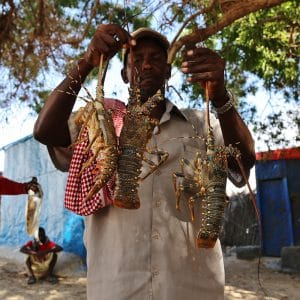
Puntland has an exceptionally long coastline, and fresh fish is available in places such as Bosaso, Eyl and other fishing communities. Fish may be grilled or fried and served with rice, pasta or flatbread. Seafood tends to be more readily available on the coast than in the interior.
Sweet Somali tea, flavoured with spices and plenty of sugar, is served throughout the day and fresh juices are also popular.
Islam is practised by almost the entire population of Puntland, with the overwhelming majority following Sunni Islam.
Islam is the official religion and plays a central role in Puntland’s laws, social customs and everyday life. In fact the Puntland constitution requires regional laws and culture to comply with Islamic principles.
Daily routines may be shaped by prayer times, particularly on Fridays. During Ramadan, most local people fast between sunrise and sunset, and visitors should avoid eating, drinking or smoking publicly during fasting hours.
Puntland has, in recent years, been seen almost entirely through the prism of piracy when it comes to the media.
Pirates of Somalia: Inside Their Hidden World — Jay Bahadur
Published in the UK as Deadly Waters, this is one of the most accessible books specifically connected to Puntland. Bahadur travelled to the region during the height of Somali piracy and spent time in Garowe, Bosaso and coastal communities associated with pirate networks. The book looks beyond dramatic hijackings to examine the politics, economics and social conditions that allowed piracy to develop.
Desert Flower — Waris Dirie
The memoir of Waris Dirie, who was born into a nomadic Somali family near Galkayo before eventually becoming an international model and campaigner. The book provides a personal account of pastoral life, family structures, migration and the experiences of women in Somali society. It also deals extensively with female genital mutilation.
Puntland has, in recent years, been seen almost entirely through the prism of piracy when it comes to the media.
An expedition to the tip of the Horn of Africa - James Willcox talk RGS
In 2016 Untamed Borders organised an expedition in search of a colonial era light-house at the very tip of the Horn of Africa - the eastern-most point of the continent (we found it). This was the first of its kind to the area in 20 years and our Founder, James Willcox, spoke at the Royal Geographical Society, about this special trip.
Pirates of Puntland — BBC News Africa
A 2024 report filmed in and around Eyl during a renewed period of piracy off the Puntland coast. The BBC speaks with fishermen, local residents, security personnel and men involved in piracy, exploring why some coastal communities believe illegal or destructive fishing has deprived them of legitimate livelihoods.
Stolen Seas
A detailed documentary about the Somali piracy industry, built around recordings from a real hostage negotiation involving the Danish-owned vessel CEC Future. It combines interviews with sailors, pirates, negotiators and maritime experts to examine both the human consequences of hijacking and the conditions that contributed to piracy.